Sunday, 6 May 2012

Gevrey-Chambertin, Bouchard Pere et Fils, 2001

Appearance: dark hue with a slight tawny rim but limited sign of age

Nose: eucalyptus, cloves & creamy oak

Palette: needed two hours open up. Initially beet root & herbs, with fully integrated tannins and not much sign of age. The highlight is a bright acidity that perpetuates a long, taught finish of balsamic & strawberries with a little dry tannin at the end.

Conclusion: despite 11 years of age this is still  in the full flush of youth. However, I expected more given the appellation and bottle age. 3* 6/10

Saturday, 5 May 2012

Bowled over by Barbaresco!


This is easily the best looking wine I have ever seen! Normally, it's the taste of a wine that is captivating. This Barbaresco was different. It had the most beguiling colour, with the brightness and clarity of a diamond and the depth and translucent crimson of a ruby. Initially, the palette was closed by the tannins, but after an hour it had blossomed into a truly remarkable wine. 4* 9/10

Wednesday, 2 May 2012

Pilgrimage to the Cote d'Or (part 2)


Having visited the Cote d'Or many times, I have learnt the hard way that villages such as Gevery-Chambertin and Puligny-Montrachet can be an expensive lottery, where high expectations are often dashed at great expense! Like its geographical location, tucked away behind Beaune, Savigny's wines are a relative backwater that sit in the shade of other more illustrious names.

However, do not mistake modesty for poor quality. There are other villages in the Cote d'Or that are more famous and make more prestigious, more expensive wines; but to my mind there is no village other than Savigny-les-Beaune that provides such consistently good wines at prices that represent such value for money.

Savigny is also home of one of the best domaines in the whole Cote d'Or, Domaine Simon Bize, whose door and wines I return to time and time again (see earlier blog entries). So, before stopping for lunch at la Cuverie restaurant (where I first encountered Monsieur Bize's wines in 2006) there was just enough time to sneak in a quick degustation.
The Domaine Simon Bize range
With only limited time, this was more of a 'speed degustation', tasting only the top and bottom of the Savigny range. We started with the 2009 Bourgogne rouge 'les Perrieres', which was outstanding given its rank and €11.50 price tag! This wine always has  incredible depth of flavour for a Bourgogne with deep, soft black fruit in keeping with the ripe 2009 vintage (2* 8/10).

I cannot recommend this wine highly enough. It is easily as good as, if not better than most producer's village or premier cru wine. Moreover, the wine is made from old vines planted in 1971 and 1974 and are over 40 years old! The vineyard itself is on a hill over looking the village of Savigny-les-Beaune.
Les Perrieres, over looking Savigny-les-Beaune
At the top of the range, the 2009 premier cru Aux Vergelesses was definitely "mineral, intense, and complex..." as noted by Bill Nanson in his excellent book, The Finest Wines of Burgundy.  Like the Bourgogne, the wine is made from exceptionally old vines planted in 1939, 1949 and 1954! Although not cheap at €27 a bottle, this wine represents excellent value for money and would easily hold its own against other more expensive wines.

The 2009 Aux Vergelesses is likely to have a short initial drinking window as Mme Bize mentioned that in a hot vintage like 2009 and 2005 this wine tends to close down after two years, before reopening anything up to fifteen years later. I found it a well rounded wine with soft, black fruit and nervy mineral tension. Very good indeed! (4* 8/ 10).

Monday, 30 April 2012

Pilgrimage to the Cote d'Or (part 1)


Le Clos de Magny, courtesy of Google's Street View
The wines of Domaine Jean-Yves Guyard are unlikely to grace the pages of 'fine wine' literature. When tourists visit the Cote d'Or, they are unlikely to cross the threshold of this domaine for a degustation. However, the wines, especially the reds, are light, fruity, and reassuringly Burgundian.

Having tasted their 2010 Cotes de Nuits-Villages the night before at dinner, the next morning I made straight for Domaine Jean-Yves Guyard in Villers-la-Faye. The domaine has only 7 hectares in both the Hautes-Cotes de Nuits and the Cote de Nuits-Villages. The latter comes entirely from le Clos de Magny, a climat in the relatively unknown village of Corgolin at the very southern tip of the Cote de Nuits.
Le Clos de Magny (on the road to the Hautes-Cotes) 
9:30 am is a little early for degustation but, when in Rome..! The 2010 Hautes-Cotes was light, bright with fresh, crunchy Pinot fruit. The Cotes de Nuits-Villages (this time the 2009) had more weight with lusher, darker fruit. Price-wise the wines are reasonable value but not when compared to a top producer's Bourgogne, such as Bize's Bourgogne at €11. See below for cellar door prices...

Bourgogne Aligote 2009 €5.50
Hautes-Cotes de Nuits 2010 €8.00
Cote de Nuits-villages 2009 €11.00

Back in the UK, the Cote de Nuits-Villages tasted even better. I never thought I'd say this but much of the improvement was down to glassware. A larger glass aerated the wine better, releasing more flavours on the nose and in the palette. My (brief) tasting note is below.

Cote de Nuits-Villages, Jean-Yves Guyard, 2009

Appearance: bright & clear
Nose: light vanilla
Palette: round & fruity, cherry & cloves with some toasty oak, sweet recurrants & strawberries on finish.
Conclusion: A decent  & easily enjoyable wine that shows the fullness of the vintage 2* 7/ 10

Monday, 23 April 2012

Burgundy (slight return)

Savigny-les-Beaune, 1er Cru Les Peuillets in the flesh
Slight return: a move partially back in an artistic direction that was abandoned or forgotten. 

Despite taking up a large part of both my cellar and blog, Burgundy has been neglected recently. A recent rip to France and Bill Nanson's brilliant book, The Finest Wines of Burgundy, have conspired to reignite my passion for Burgundy and its wine.

Stopping off in the region on the way to and back from skiing, offered the chance to see the vineyards, meet the winemakers, and taste the wines. Burgundy is the very essence of terroir. Nowhere else, except possibly Barolo, is the link between vineyard and taste more acute. While the delineation of vineyards into hundreds of individual plots, each with their own terroir, can make Burgundy confusing, it is also what makes it the most fascinating wine region in the world. Where else can you find such a range of flavours from only two grapes, pinot noir and chardonnay?

Having spent years pouring over maps, trying to locate each wine's vineyard in maps, it is always inspiring to see them 'in the flesh'. So, having spent time in the Hautes Cotes de Nuits and Savigny-les-Beaune and tasted a variety of wines, Burgundy is back!

Wednesday, 23 November 2011

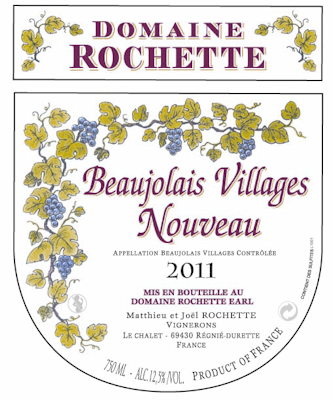
Beaujolais nouveau!

The third Thursday in November is not the grandest date in the wine calendar but it is one of the most frivolous. Last thursday was Beaujolais Nouveau day, when Beaujolais celebrates the release of its latest vintage. In stark contrast to Bordeaux's drawn out en primeur campaign, Beaujolais's latest vintage is released without fanfare for immediate enjoyment.

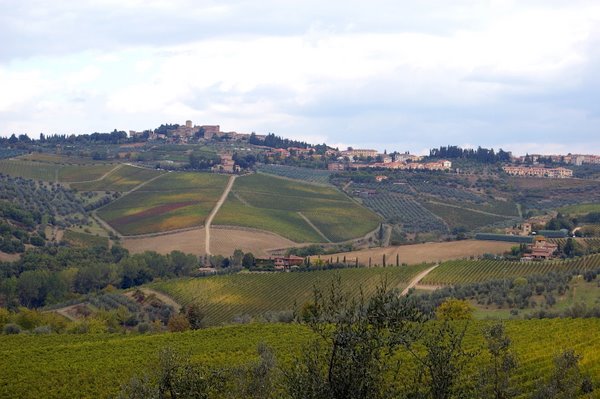
View from Domaine de la Rochette

Unlike the 'classic' mouthwash taste typical of Beaujolais Nouveau, this was a surprisingly good and already well developed wine. This could bode well for the 2011 vintage. Domaine de la Rochette in Régnié has produced a great little wine.

In true burgundian style we tasted the wine with gougères. It had a surprisingly deep violet core; attractive Beaujolais bubble gum nose; very light, silky fruit & lots of granite minerality without excessive acidty and a short 'ribena' finish. 1* 6/10

Thursday, 18 August 2011

In the beginning... Villa Cafaggio

This is the wine that started my love affair with Chianti. Villa Cafaggio is one of the best producers of Chianti and it is both widely available and excellent value.
The Conca d'Oro

Like my all time favourite Chianti, Fontodi, the Cafaggio estate is located in the "Conca d'Oro" of Panzano in the Chianti Classico region.  Not only has Tuscany been blessed with an almost uninterrupted run of excellent vintages since 1999, but it is also probably the only terroir in the world capable of harnessing sangiovese to perfection. In a world where most wines struggle to assert themselves in what has become a commoditised market, it is beyond me why Chianti producers choose to dilute their unique identity with international grapes. Thankfully, this Chianti Classico is made entirely from Sangiovese and aged in traditional Slovenian oak casks.

Villa Cafaggio, Chianti Classico, 2007

Appearance: deep & sumptuous

Nose: the nose of an older, more mature vintage with eucalyptus, cedar and herbs

Palette: sumptuous, deep and soft fruit (blackberries & leather - almost Hermitage) with an elegant balance of acidity. Middle palette fades fairly quickly but the acidity whips up lovely mature tannins & black cherry fruit into a long fruity finish.

Conclusion: still in my top 3 Chiantis. An approachable & delicious wine but where can it go from here? 3.5* 8/10

Monday, 4 July 2011

Vermouth: the insider's tipple

At the end of a recent Piemonte tasting, with puckered lips and purple teeth, I approached Roberto Bava of the eponymous winery. To my amazement, he suggested I don't bother trying his wines but have a vermouth instead. "Vermouth, isn't that an 80's throwback drink?", I thought to my self.

Wow, what a pleasant surprise! This is not just any vermouth, this is Cocchi's Vermouth di Torino. Mixed with a few ice cubes, some sparkling water and some lemon zest, this makes the most refreshing and delicious drink I have had in a very long time.

Sunday, 26 June 2011

Piemonte: the good, the bad, & the ugly


I love Italian wine. Indigenous grape varieties, an array of idiosyncratic regions,  and not to mention probably the most food friendly wines in the world with their moreish acidity. Italian wines are unmatched by any other country for their character and diversity. 

However, I am a relative newcomer to Italy and her wines and thus far I have not ventured far from the well trodden path of Tuscany and Abruzzo. Until recently, I knew the wines of Piemonte only by reputation, and so I jumped at the chance to taste some of the best the region has to offer at the Decanter Piemonte Grand Tasting. Unexpectedly, there was one common theme running through most of the wines: oak. There was a clear distinction between those producers who aged their wines in the traditional botti and those who used the more modern bariques. To my taste, the former made wines with more balance where the oak complimented and lifted the fruit, while the latter made wines that were utterly lacking in fruit and perfume, having been swamped by new oak. Here are a few highlights as I have since lost my notes! 

The good...

Barbaresco, Produttori del Barbaresco, 2006
A beautiful brown colour and an enticingly perfumed nose. Very burgundian. A lovely, well balanced wine that, although young, is drinking well now.

For a co-operative, these are superb wines. Interestingly, they produce single vineyard wines too.  The website has some great photos and details on the individual vineyards themselves. 

Roero, Sudisfa’, Angelo Negro e Figli, 2008
100% Nebbiolo and aged in botti. Herbs on the nose,  a darker colour suggesting a heavier wine but it had a nice balance between ripe fruit and light, perfumed texture. In another two years this will be perfect!

Having never tried a wine from Roero, this was a fantastic introduction to the region. In geographic terms, Roero, is opposite Barolo, but in vinuous terms it is very close, being 100% Nebbiolo. What is more, Roero's wines represent value for money - this one is approximately £30 a bottle, which is half the price of many Barolos of similar quality (bear in mind this is Piemonte!).
Moscato d’Asti, La Rosa Selvatica, Icardi, 2010
So crisp & delicate that it barely touches the palette. The bubbles lift the sweet grapey fruit and release it as they pop in the mouth. At 5%, it's light in alcohol too.


The bad...
Cortese. I like indigenous grapes, but this one has very little to offer. Piemonte, stick to the reds and the sparkling wines, your whites do you no favours!

The ugly... 
Like a horrific creation, Enzo Boglietti's wines had more in common with Frankenstein, having been constructed with the incongruous 'limbs' of Nebbiolo and rampant new oak. The fruit was caged in the oak, making these wines unpleasant to drink.


Friday, 20 May 2011

Return of the Soave


Although not in the same league as Pieropan's La Rocca, this is another really god wine from Soave. If anyone ever needed proof that the Garganega grape can rival Chardonnay for richness and Sauvignon for crispness, this is it.

The Coffeles have 25 hectares of vineyard in Soave. Made entirely from Garganega, the Soave Classico is the entry level wine to an impressive and diverse range.

Soave Classico, Coffele, 2009

Appearance: light & golden with  a green hue

Nose: clear with minerals & wild herbs

Palette: clean and crisp with some underlying honey richness and apricots. More mineral on the finish, which isn't particularly noteworthy.

Conclusion: a good wine with all the right flavours but a little two dimensional. 2.5* 6/10